Adaptive reuse · Completed 2024
Salish Sea Boathouse
Lopez Island, WA
The facts
- Location
- Lopez Island, WA
- Completed
- 2024
- Original building
- 1948
- Programme
- Working boat shop with sail loft above
- Size
- 4,100 SF
- Structure
- Existing Douglas fir post and beam, repaired in place; new glulam rafters; galvanized steel ties
01 · The site
A 1948 shed with eleven bad posts.
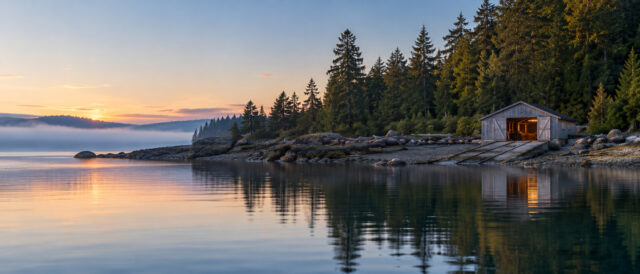
The boathouse was built in 1948, extended twice without drawings, and had spent about fifteen years holding boats up while it came down. The survey found eleven of the thirty-two fir posts rotted through at the sill and a ridge that had dropped four inches.
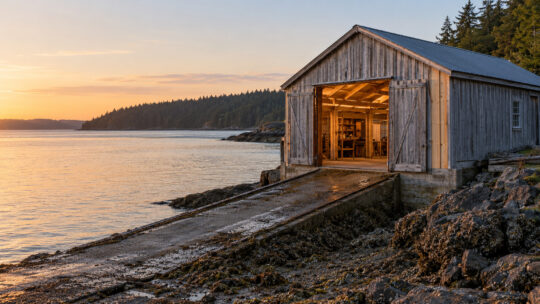
We kept the post-and-beam frame, the ridge line, the two sliding doors on the water elevation, and the concrete ways. We replaced the eleven posts, the whole roof structure, and every fastener in the building. The 1974 lean-to came off.
02 · The materials
What was there, plus galvanized steel.
Douglas fir posts and beams, repaired in place with scarf joints wherever a post had ten good feet above the rot. New glulam rafters at the original spacing. Galvanised steel ties and plates, left bright.
Nothing here is painted. The shop is a wet room with a boat in it, and on a working building a connection you can inspect is worth more than one you cannot see.
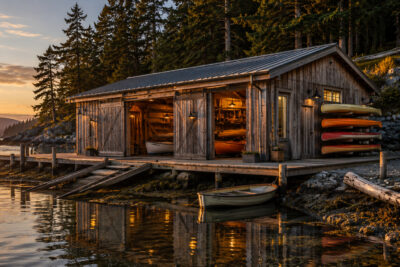
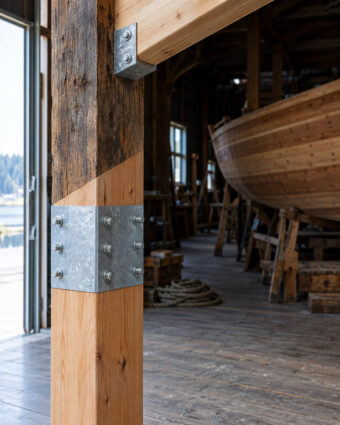
The decision worth arguing about on a 1948 shed is what to keep, and it is made before anyone lifts a bar.
03 · The decisions we’d defend
Four choices a client could argue with.
-
01
Keeping the frame
Pricing said demolition and rebuild came in four percent cheaper. The frame is the reason the building is worth converting at all, and four percent is not a reason to lose it.
-
02
New steel, left bright
Galvanizing reads as a repair rather than as a period detail. That is honest: the plates are from 2024 and the posts are from 1948, and pretending otherwise would have fooled nobody who works here.
-
03
The lean-to came off
It was added in 1974, it was framed on grade, and it was the only part of the building actively taking water into the frame.
-
04
No glazing on the water elevation
It is a shop. The doors open, which is a forty-foot window nine months of the year, and a glazed wall would have cost the wall the winches hang on.